
What is Barenia (Novonappa) Leather?
Muso GoodsWhat exactly is Barenia (or Novonappa) Leather?
In the landscape of high-end luxury leathers, few materials command the same quiet reverence as Barenia leather. Celebrated by collectors and leathercraft artisans as the ultimate "living leather," Barenia represents a rare intersection of equestrian history and luxury symbolism. Unlike heavily coated, highly processed modern leathers that remain static over their lifespan, Barenia develops a stunning patina, creating a dimensional look no other can match.
Understanding Barenia requires exploring the specialized processes of Tanneries Haas in Alsace, France.

The Historical Genesis of Barenia
The heritage of Barenia leather is fundamentally intertwined with Tanneries Haas, located in the Alsace region of France.
Originally, the leather was engineered specifically for Hermès’ equestrian workshops. Saddles demanded a material that could withstand moisture, sweat, friction, and extreme outdoor environments while remaining supple enough to prevent chafing the horse. With that in mind, Barenia was developed.
The material made a seamless transition from the stables to haute couture, becoming the signature leather for iconic handbags such as the Birkin and Kelly, as well as fine watch straps and personal accessories.
Historical Era |
Primary Use Case |
Key Functional Requirements |
19th Century (Equestrian) |
Horse saddles, harnesses, and bridles |
High tensile strength, sweat resistance, extreme suppleness |
Mid-20th Century (Transition) |
Travel trunks, early luxury luggage, small leather goods |
Structural integrity, resistance to handling marks, long-term durability |
Modern Era (Haute Couture) |
High-end handbags (Birkin, Kelly), luxury watch straps, bespoke accessories |
Velvet-smooth touch, unique natural aesthetic, rich personal patina |
How Barenia is Made
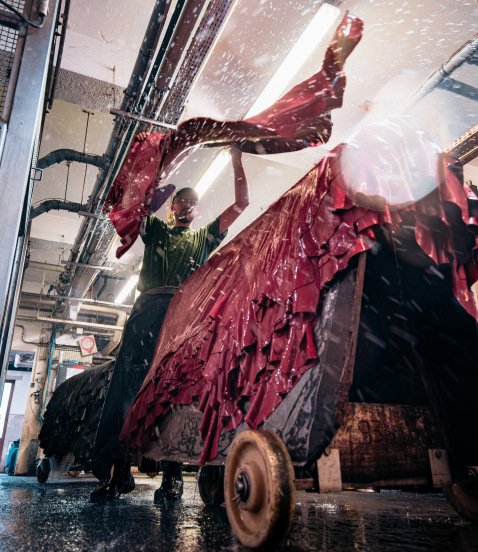
Standard modern leathers are often tanned in a matter of hours using standardized chrome formulas, but Barenia demands a complex, multi-stage hybrid sequence.
Raw Hide Selection and the Standards of Perfection
Because Barenia receives minimal surface finish, the raw calfskin hides must be entirely free of insect bites, scars, or structural blemishes. Only a tiny fraction of top-grade French calfskins meet these rigorous selection standards, as any imperfection on the living animal will be permanently visible on the finished luxury good. It is estimated that less than 4% of Tanneries Haas’ annual leather production capacity is allocated to Barenia. Yes, it is that rare.
The Chrome and Vegetable Double-Tanning Sequence
The chosen hides undergo a double-tanning process that combines chrome tanning with vegetable retanning. First, chrome tanning provides structural flexibility, tensile strength, and initial elasticity. Immediately following, a vegetable retanning process utilizing natural bark extracts, primarily oak and birch, imparts structural density, firmness, and the rich, natural undertone characteristic of saddle leather.
The Signature Stuffed Oil Bath
Following tanning, the hides are subjected to an intensive "stuffed" oil treatment. The leather is submerged in a specialized bath composed of nine different natural oils for five to six weeks. This extended immersion allows the oils to penetrate deep into the collagen fiber network of the calfskin.
Minimal Surface Finishing
Unlike standard leathers that are coated with heavy pigments or synthetic polyurethane sealants, Barenia's surface is left open and breathable (pure aniline).
Manufacturing Phase |
Core Process |
Technical Purpose |
Duration |
Phase 1: Selection |
Manual hide grading |
Eliminates blemished, scarred, or marked calf skins |
Ongoing |
Phase 2: Chrome Tan |
Chromium salt bath immersion |
Imparts elasticity, soft temper, and foundational strength |
Hours |
Phase 3: Veg Retan |
Oak & birch bark extract exposure |
Stabilizes chrome, prevents Chromium (VI), adds body |
Hours |
Phase 4: Stuffing |
Submersion in a nine-oil compound |
Fully saturates the fiber network for softness and water-beading |
5 to 6 Weeks |
Phase 5: Finishing |
Air drying and minimal surface buffing |
Preserves the natural, breathing grain of the calfskin |
Days |
Decoding the Nomenclature: Barenia versus Novonappa
A common source of confusion in luxury leathercraft is the relationship between Barenia and Novonappa. From a material perspective, they are identical. Both are full-grain, double-tanned, oil-stuffed calfskins produced by Tanneries Haas using the exact same formulas.
Major high-end brands often use Barenia as a name to refer to multiple, closely related leathers, namely Novonappa and Baranil. Baranil is a slightly matte touched leather that is otherwise very similar to Novonappa. The difference lies mainly in the light wax layer on top of the leather, giving it better weather and scratch resistance. Due to that minimal difference, they are generally used interchangeably in the fashion industry under the Barenia name.
The Science of Patina and Scratch Mitigation
What truly sets Barenia apart is their identity as "living leathers". When handled, the leather gradually absorbs the natural oils from the user's hands. Over time, this interaction, combined with exposure to sunlight and ambient moisture, oxidizes the vegetable tannins and mobilizes the internal oils, causing the leather to darken and develop a highly polished, glossy glaze that cannot be replicated by factory manufacturing means.
This high concentration of internal oils also gives the leather its unique self-healing properties. When a surface scratch occurs on Barenia, it is rarely a tear in the leather's fiber network, instead, it is typically a displacement of the surface waxes and oils. The application of light friction and warmth can restore the original finish.
How to Maintain Barenia
Caring for Barenia requires adhering to a strict "less is more" philosophy. Because the leather is already heavily saturated with natural oils, introducing typical heavy conditioning treatments can disrupt its delicate chemical balance.
To preserve Barenia leather without ruining its natural patina, one must follow these precise care guidelines:
-
Daily Care: Simply wipe down the leather with a dry, clean, non-shedding microfiber or cotton cloth to remove dust and surface oils.
-
Conditioning: Avoid heavy, highly synthetic, or overly greasy leather conditioners (such as Leather Honey), which can clog the pores, over-saturate the fibers, and permanently darken the leather. Instead, opt for gentle, non-greasy, solvent-free balms like Saphir Médaille d'Or Crème Nappa.
-
Liquid Exposure: While Barenia is naturally water-repellent and causes light rain to bead on the surface, any standing liquid should be immediately blotted away with a dry cloth. The leather should then be allowed to air-dry naturally in a cool, well-ventilated room.